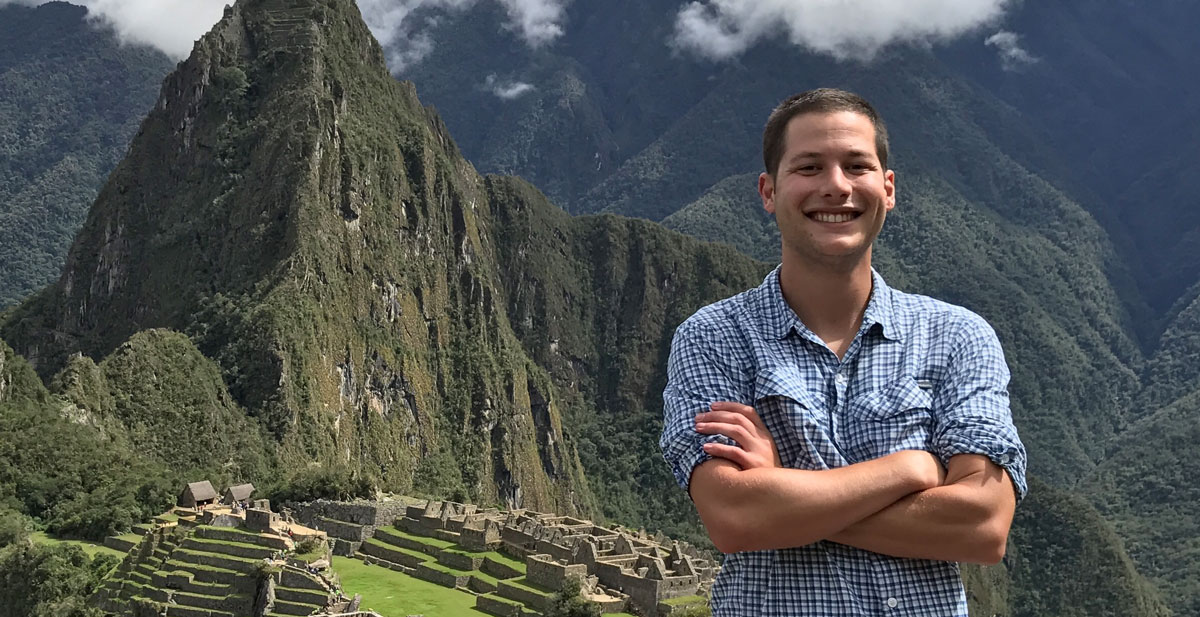
Ever since first grade, or around the time it became apparent that a pro football career was not in my future, I’ve had only one career goal: to be a sportscaster. And why wouldn’t I? Watching sporting events and talking about them is what people with actual jobs do for fun and for free. Other people work late because their boss wants the report done ASAP. When I work late, it’s because a basketball game went to overtime. For sports fans, anchoring a nightly segment about sports is like working in a candy store.
This dream inspired me to study journalism. My passion outside of sports has always been communication: reading, writing, public speaking—anything that allows people to share stories and ideas. As a child, I always likened sportscasters to professional fans, but studying journalism has shown me the difference.
The revelation came last semester, when a professor told me, “people are attracted to people. Always put the human element first in your stories.” What he was really trying to tell me was that sports journalism is not really focused on the sport itself. Rather, it’s about the people that are bound together by them. It’s about the shooting guard that’s studying biomedical sciences to honor her brother’s fight with cancer. It’s about the volleyball player that’s still playing despite severed tendons in her ankle because she feels obligated to the team. That’s the important stuff, and that’s what studying journalism has taught me to care about.
Perhaps the biggest obstacle in my life has been my mother’s illness. She contracted a rare autoimmune disease when I was seven years old that inflamed her muscles to the point where she couldn’t use them. For the next three-and-a-half years, I went through school with only one parent while my mom learned to walk, chew and perform basic bodily functions again.
I don’t want to make it sound like it was that bad on my end; mom was the truly brave one. But I am proud of the fact that I did everything possible to make it easier on my parents. Learning and getting good grades became even more of a priority because it would be a bright spot in an otherwise difficult time for mom and dad. The habits that were developed back then continue to today.
Graduating college would mean a lot, but it is not enough for me to just graduate. I’ve started off with a lot of advantages in life that could make graduating merely easy. This is why I want not only to graduate in the top one percent of my class but also to speak at the graduation ceremony. Most of all, I want to have a television job waiting for me after that ceremony is over. All of this would mean a lot more because I know I’m capable of it, and nothing is better than living up to the standards that you know you are capable of reaching.
We are proud to announce Andrew Goldstein is one of the current JustJobs Scholarship finalists. Vote for his essay (Facebook ‘Like’ and other social media sharing options in left column), click the ‘heart’ just above comments section below, and/or leave comments of support to help us with the selection process.
 In the little rural town in Lagos, Nigeria where I grew up, children had to create their own entertainment. After school, they would gather together to play sing-a-long games and create frenzied contests. I was the child who preferred to sit alone in a corner, engrossed in a storybook. The fables about Mr. Tortoise and his near fatal fall from heaven or how he challenged the hare to a marathon; these were the tales that whetted my imagination. I would make up my own stories: about an old woman’s lonely tooth, or Okon’s bicycle tires that quarreled and refused to move in the same direction.
 I was lying in a hospital bed, shortly after brain surgery, experiencing the same sense of loss and angst I had felt after losing my father. It was at this moment that my interests in clinical psychology became more focused on the goal of studying and treating child and adolescent anxiety and depression. This realization built upon the general sense I had as a teen that I wished to pursue a career in helping others. The concept of therapy and counseling was something I had an interest in as early as age 13, and by my junior year in high school, I knew that I wanted to study psychology in college. Prior to surgery, I had already developed a passion for studying this captivating field. At first, I wanted to earn a medical degree. However, early into my college education, I realized my goal was to earn a doctoral degree in clinical psychology because positive mental health is something that I value and believe is just as important as physical health.
 When I was in high school, I had a pretty rough time compared to other friends. I made a lot of poor choices, and these reflected on my academic performance. But I still managed to graduate from high school with a 3.6 GPA. During my senior year, my father and I found a 1968 Chevrolet C10 truck at an auction site. It was rusted like none other but the frame was solid, so it stole my heart. We purchased it for $1700 and brought it home to our garage in suburbia so I could work on it. When this happened, things changed in my life. I had a concrete goal: to rebuild this machine and get it running again. During this process, I realized something that is incredibly important to my life today: I loved learning. I taught myself how to rebuild that truck using the internet and the advice from my down-the-street neighbor who had a fully rebuilt GTO. This realization ultimately led me to pursue my education with vigor, and this became evident in my last semester of high school.
 I declared my major in psychology my sophomore year after observing the impact that mental illness has in the college-aged population. I have always been fascinated by the study of the mind, and from a young age, I fostered a strong inclination to help others work through their struggles. When I came to college, the need for mental health professionals became so apparent to me. In a society that promotes healthy living, psychological well-being is often downplayed. I have chosen my course of study because I believe that mental health is just as important, if not more important, than physical health.
 I intend to graduate with a B.S. degree in Biology with an emphasis in physiology and a B.A. degree in Education, Communities, and Organizations from the University of Washington-Seattle Campus. My plans after college are to apply to medical school, with the hope of one day serving a rural, underserved community. I have chosen this combination of majors because biological science and learning theory deeply intrigue me. Learning about bringing equity into communities and being able to bring in my science background to this experience would be eye-opening and rewarding. I hope to put all the lessons learned into practice in my future career as a physician. As a doctor, I would love to work with children. Knowing how to work with them and being able to relate to their everyday life is something I aspire to do successfully.
 Is there something that makes your heart leap? Is there something that gets your blood pumping? Is there something you could do all day and be completely satisfied? For me, that something is language. Now, I don’t mean just the words and grammar of languages, but rather the communication, self-expression, and transformation that comes as a result of different languages. I was a shy child, so shy that I ran out of the room during the nativity play at my church because I was so nervous…and I was Mary!